Marine Heat Exchangers: Complete Guide to Types, Working, Design, Maintenance & FAQs
1. Introduction to Marine Heat Exchangers
What is a marine heat exchanger?
A
marine heat exchanger is a critical, specialized thermal device used in ships, boats, offshore vessels, and marine power systems to efficiently transfer heat between two fluids—typically the engine's freshwater coolant and raw seawater—without mixing. This separation safeguards internal components from saltwater corrosion while harnessing the ocean's vast cooling capacity to regulate temperatures, prevent overheating, and dissipate excess heat. Unlike land-based air-cooling systems, marine designs endure corrosive environments, high pressures, and operational vibrations for reliable performance at sea.
Why are heat exchangers important in marine engines?
In marine engines, heat exchangers are vital for maintaining optimal operating temperatures, preventing overheating that could lead to mechanical failure, reduced efficiency, or safety risks. They ensure reliable performance in varying sea conditions, extending engine life and minimizing downtime.
How does a marine heat exchanger improve engine cooling?
By isolating a closed-loop freshwater coolant from corrosive seawater, it provides superior thermal management. Seawater absorbs excess heat from the coolant via thin tubes or plates, achieving up to 5 times the efficiency of direct seawater cooling while protecting internal components from salt buildup and erosion.
2. Types of Marine Heat Exchangers
2.1 Shell and Tube Marine Heat Exchangers
What is a shell and tube heat exchanger in marine applications?
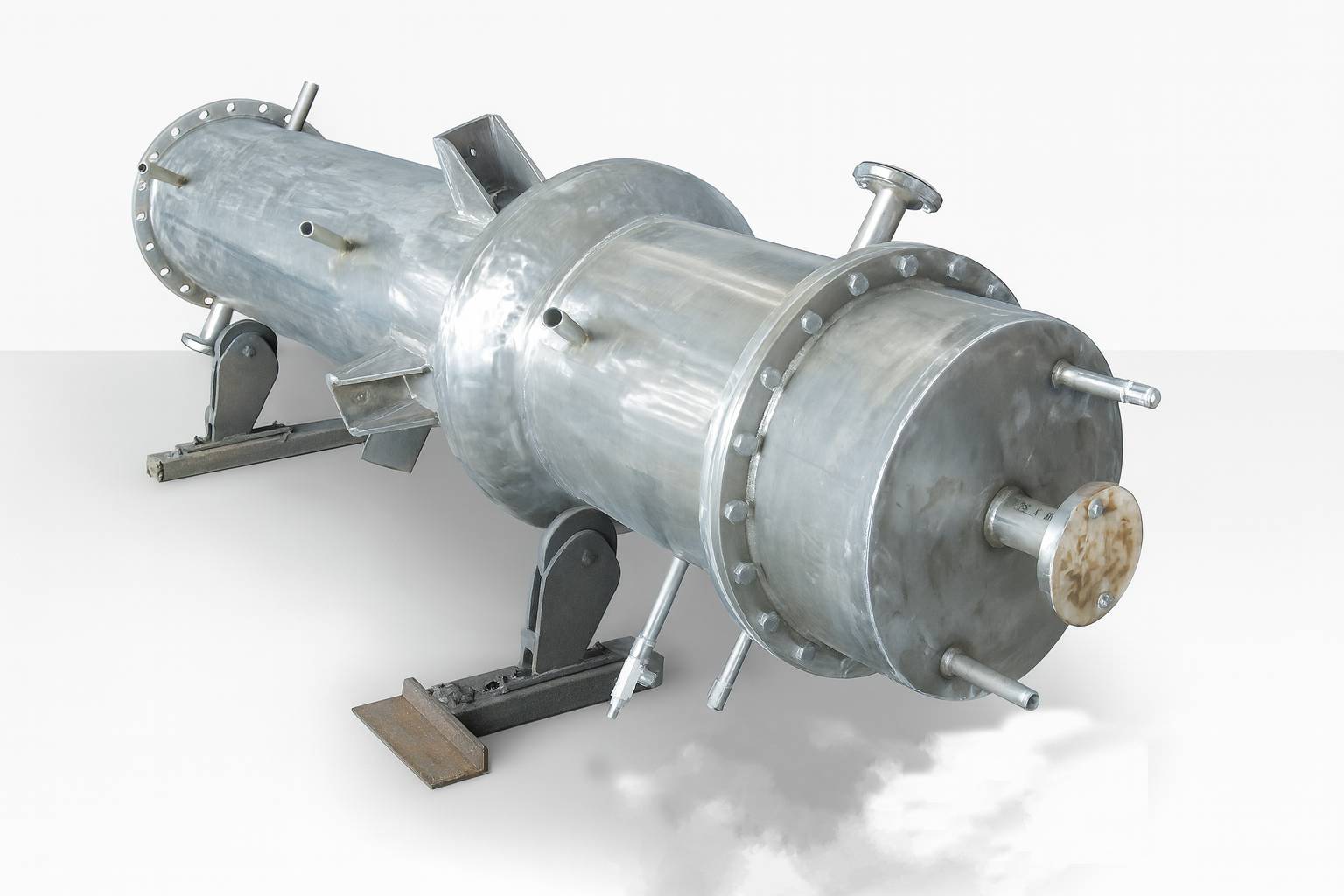
This design features a bundle of tubes encased in a cylindrical shell. One fluid flows through the tubes (e.g., engine coolant), while the other (seawater) circulates around the shell, enabling high-volume heat transfer ideal for rugged shipboard use.
Why are shell and tube exchangers preferred in ships?
They excel in high-pressure scenarios, offer easy tube replacement for maintenance, and withstand vibrations and shocks common on vessels. Their robust construction makes them a go-to for large diesel engines where reliability trumps compactness.
2.2 Plate Type Marine Heat Exchangers
How does a plate-type marine heat exchanger work?
Corrugated metal plates stack to form alternating channels for hot and cold fluids. Turbulent flow between plates maximizes contact area and heat transfer, with gaskets sealing the paths to prevent mixing.
When should plate heat exchangers be used on vessels?
Opt for them in space-constrained areas like auxiliary systems or retrofits, where high efficiency (up to 95%) and quick disassembly for cleaning are needed. Avoid ultra-high-pressure setups due to gasket limitations.
2.3 Finned Tube Marine Heat Exchangers
What are the benefits of finned tube heat exchangers in marine cooling?
Fins on tubes dramatically increase surface area for enhanced heat dissipation in compact units, improving airflow or seawater contact. They're energy-efficient, reduce fan power needs, and resist fouling better in low-velocity marine flows.
2.4 Condensers & Evaporators (Marine HVAC & Refrigeration)
What is the role of condensers in marine HVAC systems?
Condensers reject heat from refrigerant vapor, condensing it to liquid using seawater as the cooling medium. This maintains cabin comfort on ships by enabling efficient air conditioning cycles in humid, variable climates.
How do evaporators function in marine refrigeration?
Evaporators absorb heat from refrigerated spaces (e.g., cargo holds) by evaporating low-pressure refrigerant, cooling air or products. Paired with seawater-cooled condensers, they ensure precise temperature control for perishable goods during voyages.
3. Working Principle of Marine Heat Exchangers
How does a marine heat exchanger work?
Heat transfers via conduction across a thin metal barrier between fluids, driven by temperature differences. Convection within each fluid stream enhances the process, with designs optimizing counterflow for maximum efficiency.
What is the flow process in a marine heat exchanger?
Fluids flow in parallel or countercurrent paths—counterflow is preferred for superior temperature gradients. Seawater enters cool, absorbs heat, and exits warm; coolant enters hot and leaves cooled, often in a single-pass or multi-pass configuration.
What is the difference between raw water cooling and freshwater cooling in ships?
Raw water cooling pumps corrosive seawater directly through the engine, risking scaling and erosion. Freshwater cooling uses a closed loop with a heat exchanger to transfer heat to seawater indirectly, protecting the engine while using seawater's abundance for ultimate dissipation.
4. Construction & Materials
What materials are used in marine heat exchanger construction?
Common choices include copper-nickel alloys (Cu-Ni), stainless steel (e.g., 316L), titanium, and aluminum bronzes. Tubes are seamless for durability, with shells often welded for pressure integrity.
Why are copper-nickel (Cu-Ni) materials commonly used in marine applications?
Cu-Ni forms a protective oxide film in seawater, offering exceptional resistance to corrosion, biofouling, and velocity-induced erosion. Its high thermal conductivity ensures efficient heat transfer in demanding conditions.
Which materials best resist seawater corrosion?
Cu-Ni 90/10 and 70/30 alloys top the list for their self-passivating layer, outperforming stainless steel in oxygenated seawater. Titanium excels in highly aggressive environments but at higher cost.
5. Applications of Marine Heat Exchangers
Where are marine heat exchangers used on ships?
They're integral to main propulsion engines, auxiliary generators, hydraulic systems, HVAC, and refrigeration units, cooling everything from lube oil to compressed air across cargo, passenger, and naval vessels.
What type of heat exchanger is used in marine diesel engines?
Shell-and-tube designs dominate for their robustness and capacity to handle high heat loads from combustion, often with Cu-Ni tubes for seawater sides.
How do heat exchangers support marine hydraulic systems?
They cool hydraulic fluids to prevent viscosity breakdown and component wear, maintaining system efficiency during heavy loads like winches or thrusters. Compact plate types are common here for quick response.
6. Advantages of Marine Heat Exchangers
What are the main advantages of marine heat exchangers?
They deliver high thermal efficiency, compact footprints, corrosion isolation, and adaptability to seawater's cooling potential, outperforming air systems in humid, salty conditions.
How do marine heat exchangers reduce maintenance costs?
Durable materials like Cu-Ni minimize corrosion repairs, while modular designs allow easy cleaning without full disassembly. Regular upkeep can cut downtime by 50%, lowering overall lifecycle expenses.
Why are they more efficient than air-cooled systems at sea?
Seawater's superior heat capacity (4x air's) enables smaller units with 2-3x better transfer rates. Air coolers struggle with high humidity and low velocities on deck, leading to derating.
7. Marine Heat Exchanger Maintenance
How often should a marine heat exchanger be cleaned?
Inspect and clean every 6-12 months, or more frequently in turbid waters. Annual freshwater flushes prevent buildup, extending service intervals based on usage and water quality.
What are common marine heat exchanger problems?
Fouling from algae/sediment, corrosion pitting, tube leaks, and gasket failures top the list, often triggered by poor water quality or neglected filters.
How do you detect fouling or scaling in marine cooling systems?
Monitor rising coolant temperatures, pressure drops across the unit, or reduced flow rates. Visual endoscopy or ultrasonic thickness gauging confirms deposits without disassembly.
What causes tube leaks in marine heat exchangers?
Erosion from high-velocity debris, galvanic corrosion between dissimilar metals, fatigue from vibrations, or manufacturing defects weaken tubes over time.
8. Troubleshooting & Repair
Why is my marine heat exchanger overheating?
Likely culprits include biofouling blocking flow, air pockets in coolant lines, or pump failures reducing circulation. Check strainers first for simple fixes.
What causes pressure drop in marine heat exchangers?
Clogged tubes from scaling/sediment or collapsed fins restrict flow. Debris in seawater intakes exacerbates this in shallow or silty waters.
How do you repair a leaking marine heat exchanger?
Isolate the leak via pressure testing, then patch with epoxy or replace individual tubes. For extensive damage, retube the bundle or opt for full replacement to restore integrity.
9. Selection Guide
How do I choose the right marine heat exchanger?
Evaluate heat duty, fluid properties, space constraints, and pressure ratings. Consult TEMA standards for vessel-specific sizing and prioritize fouling-resistant designs for open-ocean use.
What factors affect the size of a marine heat exchanger?
Key influencers: Required heat transfer rate (Q), inlet/outlet temperatures, flow velocities, and fouling factors. Larger duties demand more surface area to maintain efficiency.
Should I choose a plate or shell & tube marine exchanger?
Select plate for high-efficiency, low-space needs like auxiliaries; shell-and-tube for high-pressure, heavy-duty applications like main engines. Plates clean easier but handle less pressure.
10. Marine Heat Exchanger Efficiency
How do you improve the efficiency of a marine heat exchanger?
Enhance with counterflow arrangements, add fins for area boost, and maintain low fouling via chlorination. Variable-speed pumps optimize flow for partial loads.
What is the impact of seawater quality on heat exchanger performance?
Turbid or polluted water accelerates biofouling, slashing efficiency by 20-50% through reduced conductivity. Cleaner, oxygenated seawater supports stable oxide films on Cu-Ni surfaces.
How does fouling affect marine heat exchanger efficiency?
Deposits insulate surfaces, increasing thermal resistance and dropping heat transfer by up to 40%, which hikes fuel use by 10% and risks overheating.
11. Comparison With Other Cooling Systems
Marine Heat Exchanger vs. Keel Cooler – which is better?
Heat exchangers offer higher efficiency via thru-hull seawater but require intakes; keel coolers eliminate thru-hulls for safer shallow drafts, though they're less effective in warm or low-flow waters.
How does a marine radiator compare to a heat exchanger?
Radiators use air for cooling, suiting freshwater or enclosed spaces but underperforming at sea due to humidity; heat exchangers leverage seawater's density for 3x better dissipation in open water.
What is the difference between direct cooling and heat exchanger cooling in boats?
Direct (raw water) exposes engines to corrosion and scaling; heat exchanger (indirect) shields with freshwater loops, boosting longevity but adding complexity and cost.
12. Industry Standards & Certifications
What standards apply to marine heat exchangers (ABS, DNV, BV)?
ABS (American Bureau of Shipping) focuses on structural integrity; DNV (Det Norske Veritas) emphasizes environmental compliance; BV (Bureau Veritas) covers pressure vessel safety. All align with ASME and TEMA for global interoperability.
Why is certification important for marine cooling equipment?
It verifies design against rigorous tests for pressure, corrosion, and vibration, ensuring seaworthiness, insurance eligibility, and regulatory compliance to avert failures at sea.
13. Marine Heat Exchanger Design
What are the design considerations for marine heat exchangers?
Account for fouling margins (20-30% extra area), vibration damping, compact footprints, and biofouling coatings. Flow velocities (1-2 m/s) balance erosion and efficiency.
How is heat transfer calculated in marine conditions?
Use Q = U × A × LMTD, where Q is duty, U overall coefficient (200-4000 W/m²K for seawater), A area, and LMTD log mean temperature difference. Factor in fouling resistance (0.0002-0.001 m²K/W).
What design features improve resistance to corrosion & biofouling?
Cu-Ni tubes with iron seeding for film acceleration, antimicrobial coatings, and wide-channel plates reduce stagnation. Chlorination ports enable in-situ treatment.
14. FAQ (High-Volume Questions)
How long does a marine heat exchanger last?
With proper maintenance, 10-20 years, though Cu-Ni models in clean water can exceed 25. Harsh conditions shorten this to 8-12 years.
Can a marine heat exchanger be cleaned without removal?
Yes, via chemical circulation (e.g., acid flushes) or high-pressure jets through access ports, ideal for routine descaling without dry-docking.
What is the typical cost of a marine heat exchanger?
$500-$5,000 for small boat units; $10,000-$50,000 for ship-scale, varying by type, materials, and capacity. Installation adds 20-30%.
Can I upgrade my existing marine heat exchanger?
Absolutely—swap to plate types for 20-30% efficiency gains or add smart sensors for predictive maintenance. Ensure compatibility with engine specs.