
UNITED COOLING SYSTEMS PVT LTD · INDUSTRIAL COOLING GUIDE
Reliable cooling begins with understanding where the heat goes. Learn how cooling towers reject process heat, what determines their capacity and how to select a system for your site.
What is a cooling tower? A cooling tower is equipment that rejects unwanted heat from a water circuit to the atmosphere. In a wet cooling tower, a small portion of the circulating water evaporates, removing heat and cooling the remaining water for reuse. These systems serve industrial processes and water-cooled air-conditioning plants.
A factory can have an adequately sized heat exchanger and still struggle with high process temperatures if its cooling-water system cannot reject the heat. The same problem can affect a chiller plant when warm condenser water increases the refrigeration system’s workload.
Choosing a cooling tower therefore involves more than matching a catalogue capacity. Water flow, temperature targets, local weather, water quality, installation layout and maintenance access all influence the result. This guide connects those inputs to the equipment decisions that matter.
How Does a Cooling Tower Work?
In an open evaporative cooling system, water absorbs heat in a condenser or process heat exchanger and returns to the tower. A distribution system spreads the warm water over internal surfaces called fill. Air passes through the wetted area, and some of the water evaporates into the air stream.
Evaporation requires energy. Taking that energy from the water helps cool the remaining liquid, which collects in the cold-water basin and circulates back to the equipment. The outgoing air carries heat and moisture into the atmosphere.
- Collect the process heat. Circulating water takes up heat from equipment or a separated process stream.
- Distribute the warm water. Nozzles or distribution basins spread water across the tower’s heat-transfer area.
- Bring water and air into contact. Fill increases the opportunity for heat and mass transfer.
- Return cooled water to the circuit. The basin collects cooled water while make-up water replaces losses.
The circulating water is reused, but an evaporative system is not water-free. Evaporation, controlled discharge and small droplet losses must be included in the utility balance. A dry cooling system works differently: air removes heat across a coil wall without intentional evaporation of the circulating fluid.
Main Cooling Tower Components and Their Functions
A tower’s thermal rating depends on its components working together. A larger fan cannot reliably compensate for blocked fill, poor water distribution or a restricted air inlet.
| Component | What it does | What to check |
|---|---|---|
| Fill media | Promotes contact between air and water | Fouling tendency, temperature suitability and access for replacement |
| Water distribution system | Spreads warm water across the available fill | Nozzle condition, operating pressure and uniform coverage |
| Fan and drive | Moves air through a mechanical-draft tower | Airflow, power, vibration, noise and maintenance access |
| Drift eliminators | Capture entrained liquid droplets from the leaving air | Condition, correct installation and the specified drift rate |
| Cold-water basin | Collects water returning to the system | Cleanability, level control, drainage and pump suction conditions |
| Louvers and air inlets | Admit air and help limit splash-out | Clearances, blockages and exposure to nearby contaminants |
| Make-up and blowdown controls | Manage water level and dissolved-solids concentration | Metering, sensor calibration and valve operation |
Drift is not evaporation. Drift consists of liquid droplets carried out by airflow. Evaporation is water becoming vapour. Drift eliminators reduce droplet carryover; they do not recover the water consumed by evaporation.
Types of Cooling Towers: Understand the Different Classifications
Cooling towers are classified by their water circuit, airflow arrangement, draft method and construction. These descriptions overlap. For example, one unit can be an open-circuit, counterflow, induced-draft tower with an FRP casing.
Open-circuit cooling towers
The circulating water comes into direct contact with air. This is a common arrangement for condenser-water and industrial cooling circuits. Treatment and filtration must address the contaminants and minerals introduced through air exposure and make-up water.
Main question: can the connected equipment tolerate an open cooling-water circuit?
Closed-circuit cooling towers
The process fluid remains inside a coil while an external spray-water circuit and airflow reject heat. This separates the process fluid from tower air and spray water. The external evaporative circuit still requires treatment and maintenance.
Main question: is process-fluid isolation worth the added coil resistance and maintenance scope?
Induced-draft towers
A fan on the discharge side draws air through the tower. The arrangement is widely used in mechanical-draft systems. Fan location, discharge conditions and neighbouring structures all influence installation and service requirements.
Main question: is there adequate clearance for discharge airflow and fan maintenance?
Forced-draft towers
A fan at the inlet pushes air through the equipment. This changes the fan’s operating environment and the way air enters and leaves the tower. The layout must still prevent warm, moist discharge air from returning to the inlet.
Main question: how will inlet conditions, discharge velocity and site layout affect recirculation?
Natural-draft towers
Air movement is driven by density differences rather than tower fans. Large natural-draft structures are associated with substantial heat-rejection duties. Their civil works and scale make them a different proposition from a packaged factory cooling tower.
Main question: does the project scale justify a site-built structure?
Dry and hybrid cooling systems
Dry coolers transfer heat through finned coils to ambient air. Hybrid arrangements combine dry and evaporative features in different ways. They can trade capital cost, water use and power consumption against seasonal performance.
Main question: what water-use limit and outlet temperature must the system achieve?
Where does an FRP cooling tower fit?
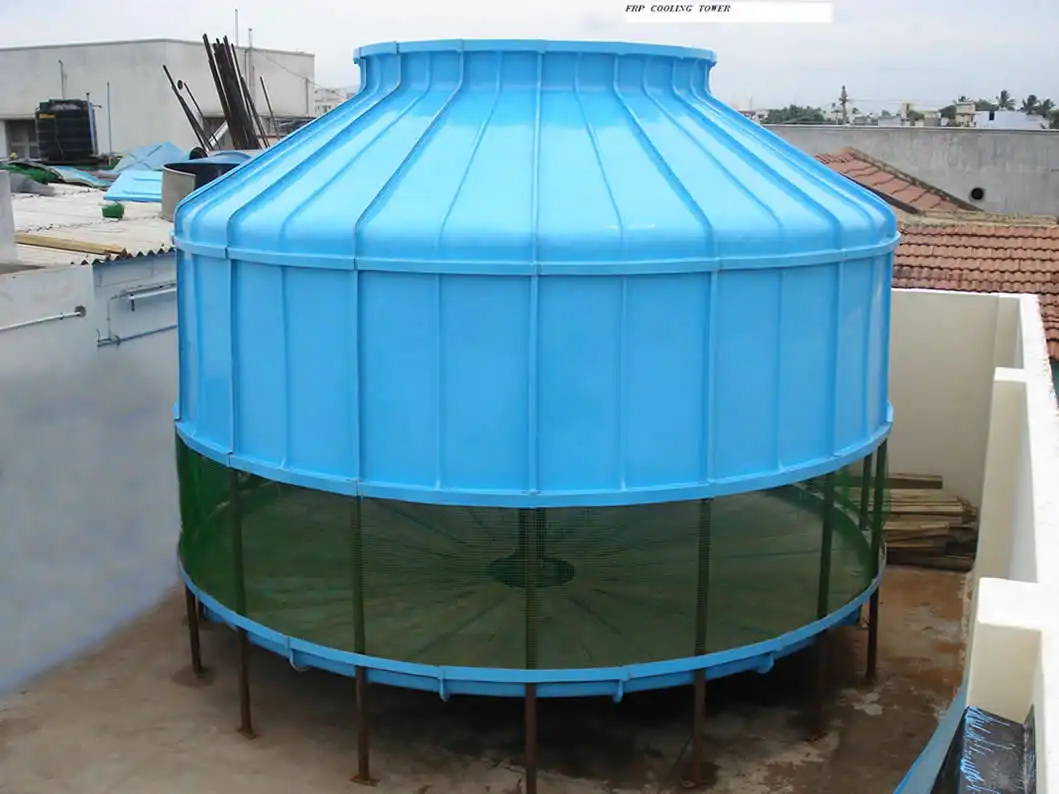
FRP means fibre-reinforced plastic, a construction material rather than a separate cooling principle. An FRP casing can offer corrosion resistance and low weight, but the complete unit also contains structural members, fill, fasteners, fans and other components. Assess the whole assembly against the site environment and operating temperature.
Crossflow vs Counterflow Cooling Towers
In a crossflow tower, air moves across the falling water. In a counterflow tower, air moves upward against the downward water flow. Both can deliver a specified duty when correctly selected; neither label alone establishes better performance.
| Comparison point | Crossflow | Counterflow |
|---|---|---|
| Air and water direction | Air crosses the falling water | Air rises against the falling water |
| Water distribution | Often uses gravity-fed hot-water basins | Often uses pressurised spray distribution |
| Access considerations | Basin and fill access depend on the layout | Spray-system and internal access depend on the layout |
| What to compare in a bid | Rated temperatures, wet-bulb basis, footprint, fan power, required pump head, noise and service clearance | |
If a proposal is described as “more efficient,” ask whether that means lower fan energy, reduced pumping head, a smaller footprint or a closer temperature approach. These benefits are not interchangeable.
Cooling Tower Range, Approach and Wet-Bulb Temperature
Three temperature terms make cooling tower specifications much easier to understand. Read them together rather than treating the cold-water temperature as an independent guarantee.
Wet-bulb temperature: the evaporative cooling reference
Entering-air wet-bulb temperature reflects both heat and moisture in the air. It is the key environmental reference for conventional evaporative tower selection. Dry-bulb temperature—the ordinary air temperature—is the key reference for sensible dry cooling.
A wet cooling tower can cool water below the air’s dry-bulb temperature under suitable conditions. In normal steady operation, however, it cannot deliver water below the entering-air wet-bulb temperature. A real tower needs a positive temperature difference to drive the process.
Range: how much the circulating water cools
Example: 37°C − 32°C = 5°C range
Approach: how close the outlet gets to wet-bulb
Example: 32°C − 27°C = 5°C approach
At a given duty, flow and entering-air condition, achieving a smaller approach generally requires a more demanding tower selection. A large range alone does not prove that a tower is working well: range also reflects the process heat load and circulation rate.
Why location matters: A tower selected for a 27°C wet-bulb design condition cannot be assumed to maintain the same cold-water temperature when the actual entering wet-bulb is higher. Use appropriate site weather data and account for discharge-air recirculation.
Cooling Tower Capacity Calculation: A Practical Example
For circulating water with approximately constant properties, estimate the rejected heat from the water flow and temperature range:
Q in kW · mass flow ṁ in kg/s · specific heat cp in kJ/kg·K · water temperature range ΔT in K
Using water density of approximately 1,000 kg/m³ and specific heat of approximately 4.186 kJ/kg·K gives a convenient preliminary expression:
Illustrative duty: A process circulates 100 m³/h of water. Water returns to the tower at 37°C and must leave at 32°C. The estimated duty is 1.163 × 100 × 5 = 581.5 kW. If the design entering wet-bulb temperature is 27°C, the specified approach is 5°C.
The supplier therefore needs to select for approximately 582 kW at 100 m³/h, 37°C entering water, 32°C leaving water and 27°C entering wet-bulb. The heat-load calculation does not determine the tower’s physical dimensions or fan power; those require the manufacturer’s thermal selection.
Why a “TR” figure can be misleading
One refrigeration ton represents approximately 3.517 kW of refrigeration capacity. Cooling-tower nominal ton ratings may use a different heat-rejection convention. In a water-cooled chiller system, the condenser rejects the evaporator cooling load plus the compressor energy entering the refrigeration cycle. Do not match a tower to the chiller’s nominal tonnage without checking the actual condenser duty and rating basis.
A better enquiry: Provide kW heat rejection, water flow, hot- and cold-water temperatures, design wet-bulb and allowable hydraulic conditions. Ask the supplier to state the exact basis of any tonnage quoted.
Need Help Defining Your Cooling Duty?
Share your circulation rate, temperature targets and site conditions with united cooling systems pvt ltd. Start with a clear duty so equipment options can be compared meaningfully.
Discuss Your Cooling RequirementView the Enquiry ChecklistCooling Tower vs Chiller vs Dry Cooler
These systems often work together, but they perform different jobs. A cooling tower is primarily a heat-rejection device. A chiller uses a refrigeration cycle to produce cooling at a controlled temperature, including temperatures below ambient conditions when designed for that duty.
| Equipment | How it removes heat | Key selection limit |
|---|---|---|
| Wet cooling tower | Evaporation and sensible exchange with air | Entering wet-bulb, approach, water availability and treatment |
| Dry cooler | Sensible heat transfer from a coil to air | Entering dry-bulb, coil area, airflow and desired outlet temperature |
| Chiller | Refrigeration cycle transfers heat to another sink | Required chilled-fluid temperature, refrigeration capacity and power |
| Process heat exchanger | Transfers heat between the process and a cooling medium | Utility temperature, transfer area, materials and pressure drop |
A process may use a shell-and-tube heat exchanger to keep product separate from cooling water, with a tower rejecting the collected heat. The process outlet temperature must allow for temperature differences across both pieces of equipment.
Where Are Cooling Towers Used?
Manufacturing and process cooling
Plastics plants, metalworking facilities, compressor installations and other manufacturing operations use cooling-water systems to carry away production heat. The water may cool machinery directly where suitable, or serve an intermediate heat exchanger that protects a cleaner process circuit.
HVAC and commercial buildings
Water-cooled chillers reject condenser heat through a cooling-water loop. Tower operation then affects the chiller plant’s energy use as well as its cooling capacity. Building applications also place emphasis on noise, roof loading, airflow clearance and separation from ventilation intakes.
Chemical, power and larger industrial facilities
Plants with multiple users may have a central cooling-water network. Changes in one user’s flow or heat load can affect others, so tower selection should reflect the combined operating scenarios and the intended level of redundancy.
For food, pharmaceutical and other sensitive processes, a cooling tower does not by itself establish hygienic suitability. The process boundary, heat exchanger construction and cooling-water quality need to be specified separately.
Cooling Tower Water Consumption, Blowdown and Cycles of Concentration
An evaporative tower’s make-up demand is not its circulation rate. Most circulating water returns repeatedly through the system. Make-up replaces the water that actually leaves.
Other losses can include leakage, overflow and deliberate draining.
Evaporation leaves most dissolved minerals behind. Their concentration rises unless some circulating water is removed and replaced. This controlled removal is called blowdown. The balance matters: insufficient blowdown can worsen scaling or corrosion, while excessive blowdown wastes water and treatment chemicals.
What are cycles of concentration?
Cycles of concentration compare a suitable dissolved constituent in the recirculating water with the same constituent in the make-up water. Conductivity is often used as an operating indicator, with interpretation appropriate to the treatment programme and water chemistry.
Under a simplified steady-state balance, with negligible drift and other losses, blowdown is approximately evaporation divided by one less than the cycles of concentration:
B: blowdown · E: evaporation · C: cycles of concentration
Water-balance illustration: If evaporation is assumed to be 1.0 m³/h and the approved operating target is four cycles, blowdown is approximately 1 ÷ (4 − 1) = 0.33 m³/h. Make-up is then approximately 1.33 m³/h before other losses. This assumed evaporation rate is separate from the earlier thermal sizing example.
Increasing cycles can reduce blowdown, but the safe target depends on make-up water, temperatures, materials and treatment. Meter make-up and blowdown, check basin level controls and investigate unexplained losses. Side-stream filtration can remove suspended solids; it does not remove all dissolved salts or replace microbiological control.
Cooling Tower Materials and Fill Selection
Choose materials for the actual environment, not just the purchase price. Coastal air, industrial contaminants, water chemistry and sunlight exposure can affect the casing and structural parts differently. A corrosion-resistant casing does not automatically protect metal fasteners, supports or drives.
FRP, galvanised steel, stainless steel and concrete each appear in cooling tower construction for different reasons. The proposed design should identify where each material is used, the corrosion protection provided and how damaged components can be repaired or replaced.
Film fill vs splash fill
Film fill spreads water over closely spaced surfaces, providing substantial contact area in a compact volume. Splash fill repeatedly breaks up falling water and can suit some more fouling-prone duties. Actual selection depends on water cleanliness, solids, temperature and the fill geometry; a material label alone does not establish fouling resistance.
When replacing fill, check more than its dimensions. A different fill type changes airflow resistance, water distribution and structural loading. The replacement should be compatible with the tower’s thermal and mechanical design.
How to Select a Cooling Tower for Your Plant
A well-prepared specification helps suppliers quote the same duty and reduces surprises during commissioning. Begin with the process requirement and then evaluate site constraints.
- Define the thermal duty. Provide water flow, inlet temperature, required outlet temperature and the expected minimum and maximum heat loads.
- Confirm the weather basis. Specify the design entering wet-bulb for evaporative service, or dry-bulb for dry service, along with location and elevation.
- Describe the water supply. Include make-up availability and analysis, treatment expectations, allowable discharge and any seasonal supply restrictions.
- Choose the circuit arrangement. Decide whether the process can use open tower water or needs isolation through a coil or separate heat exchanger.
- Check the installation. Assess clearances, foundations, operating weight, access, piping, pump requirements, noise and potential air recirculation.
- Plan reliability. Define what happens during cleaning, fan failure or a production expansion. Multiple cells can support staged operation, but redundancy must be checked at the specified load.
- Agree performance evidence. Request the thermal selection, fan and pump requirements, drift specification and applicable testing or certification details.
Where CTI thermal certification is a project requirement, ask for confirmation that the exact proposed product line and model are covered by the applicable programme. Certification of thermal performance should not be read as a guarantee of installation quality, water hygiene or every aspect of equipment operation.
Cooling Tower Maintenance and Common Operating Problems
Establish a baseline when the tower is commissioned. Record water flow, hot- and cold-water temperatures, entering-air conditions, fan operation, water chemistry and make-up consumption. Trends become useful when compared at similar heat loads and weather conditions.
| Symptom | Possible causes | Initial checks |
|---|---|---|
| Cold-water temperature is too high | Higher wet-bulb, higher load, restricted airflow, fouled fill or poor distribution | Compare actual conditions with the selection and inspect flow paths |
| Uneven wetting or dry fill areas | Blocked nozzles, insufficient distribution pressure or imbalance | Check distribution-system condition and operating flow |
| Unusual make-up demand | Leaks, overflow, excessive blowdown or increased evaporation load | Review meters, basin level control and blowdown operation |
| Fan vibration or abnormal noise | Imbalance, looseness, bearing or drive problems | Follow the manufacturer’s shutdown and inspection procedure |
| Rising deposits or corrosion | Water-chemistry changes or treatment/control problems | Review analysis, dosing records and conductivity controls |
Water hygiene belongs in the operating plan
Both open- and closed-circuit evaporative towers can support Legionella growth in their exposed water systems. CDC guidance emphasises a water management programme covering scale, corrosion, sediment, cleaning and disinfectant control. Assign responsibilities, monitoring limits, corrective actions and records; use qualified water-treatment support for site-specific procedures.
Do not assume that clear-looking water or a closed process coil eliminates this risk. Plan cleaning and disinfection around manufacturer guidance, the water management programme and applicable local requirements. Consider ventilation intakes and exposure pathways when locating the tower. See the CDC cooling tower guidance.
For mechanical work, isolate the equipment using the site’s approved procedure before accessing fans, drives or internal components. Maintain safe access for routine inspections so that essential maintenance remains practical throughout the equipment’s life.
How to Improve Cooling Tower Efficiency and Control Cost
Optimise the cooling system as a whole. Lower fan power can look attractive while warmer condenser water increases chiller electricity use. Conversely, driving tower fans harder may provide little benefit if the process does not need colder water.
Variable-speed fans and sensible cell staging can match airflow to changing loads, within the equipment’s operating limits. Maintain even water distribution and keep air passages clear before considering more ambitious control changes. Review setpoints together with the connected chiller or process requirements.
For procurement, compare more than the tower’s supply price. Include foundations, lifting, piping, pumps, electrical work, controls, water treatment, cleaning access and commissioning. Over time, fan and pump energy, water, chemicals, repairs and downtime can be substantial parts of ownership cost.
Compare like with like: Ask each supplier to quote the same flow, temperatures, wet-bulb basis, noise conditions and scope of supply. A lower price means little if the proposed unit is rated for easier weather or excludes equipment that another offer includes.
Frequently Asked Questions About Cooling Towers
What is the main purpose of a cooling tower?
A cooling tower rejects unwanted heat from a circulating water system to the atmosphere. In an evaporative tower, a portion of the water evaporates and helps cool the water that returns to the plant.
Can a cooling tower cool water below ambient temperature?
A wet tower can cool below the ambient dry-bulb temperature when evaporation provides the cooling. In normal steady operation, its outlet remains above the entering-air wet-bulb temperature. A conventional dry cooler is limited by dry-bulb conditions.
What is the difference between range and approach?
Range is the hot-water inlet temperature minus the cold-water outlet temperature. Approach is the cold-water outlet temperature minus the entering-air wet-bulb temperature.
Does a closed-circuit cooling tower consume water?
Yes, when operating evaporatively. The process fluid stays inside a coil, but the separate spray-water circuit loses water through evaporation and blowdown and therefore needs make-up water and treatment.
Is a cooling tower the same as a chiller?
No. A chiller uses refrigeration to provide cooling at a required temperature. A cooling tower rejects heat to the atmosphere and often serves the condenser-water side of a water-cooled chiller system.
How do I calculate cooling tower capacity?
For water, preliminary heat rejection in kW is approximately 1.163 multiplied by circulation in m³/h and temperature range in °C. Tower selection also requires the wet-bulb temperature, desired outlet temperature and site conditions.
Why does a cooling tower need blowdown?
Evaporation concentrates dissolved minerals in the remaining water. Controlled blowdown removes some concentrated water so make-up water can dilute the circuit. The target should be set using water analysis and the treatment programme.
Is visible cooling tower plume the same as drift?
No. A visible plume can form when moist discharge air mixes with cooler surroundings and water vapour condenses. Drift is liquid droplets carried from the tower. Plume appearance alone does not establish the drift rate.
What information should I send for a cooling tower quotation?
Send water flow, hot- and cold-water temperatures, design wet-bulb, location, water analysis, available space, electrical supply, noise requirements and operating schedule. Include current drawings and performance data for replacement projects.
Discuss Your Cooling Tower Requirement with united cooling systems pvt ltd
united cooling systems pvt ltd provides industrial thermal-equipment support and states that it assists customers with cooling tower model and size selection. Its published range includes dry cooling tower solutions. Discuss the appropriate equipment and confirmed supply scope for your particular project.
For a new installation, share the expected heat load, temperature targets and site utility conditions. For a replacement, explain the problem with the existing system: high outlet temperature, recurring fouling, water consumption, noise or maintenance difficulty. That information helps frame the enquiry around the outcome your plant needs.
Start with Your Process. Specify the Right Cooling System.
Send your cooling-water duty and site details to united cooling systems pvt ltd to discuss equipment options and request a project-specific quotation.
Request a Cooling Tower QuoteView Dry Cooling Solutions