What is a Natural-draft cooling tower?
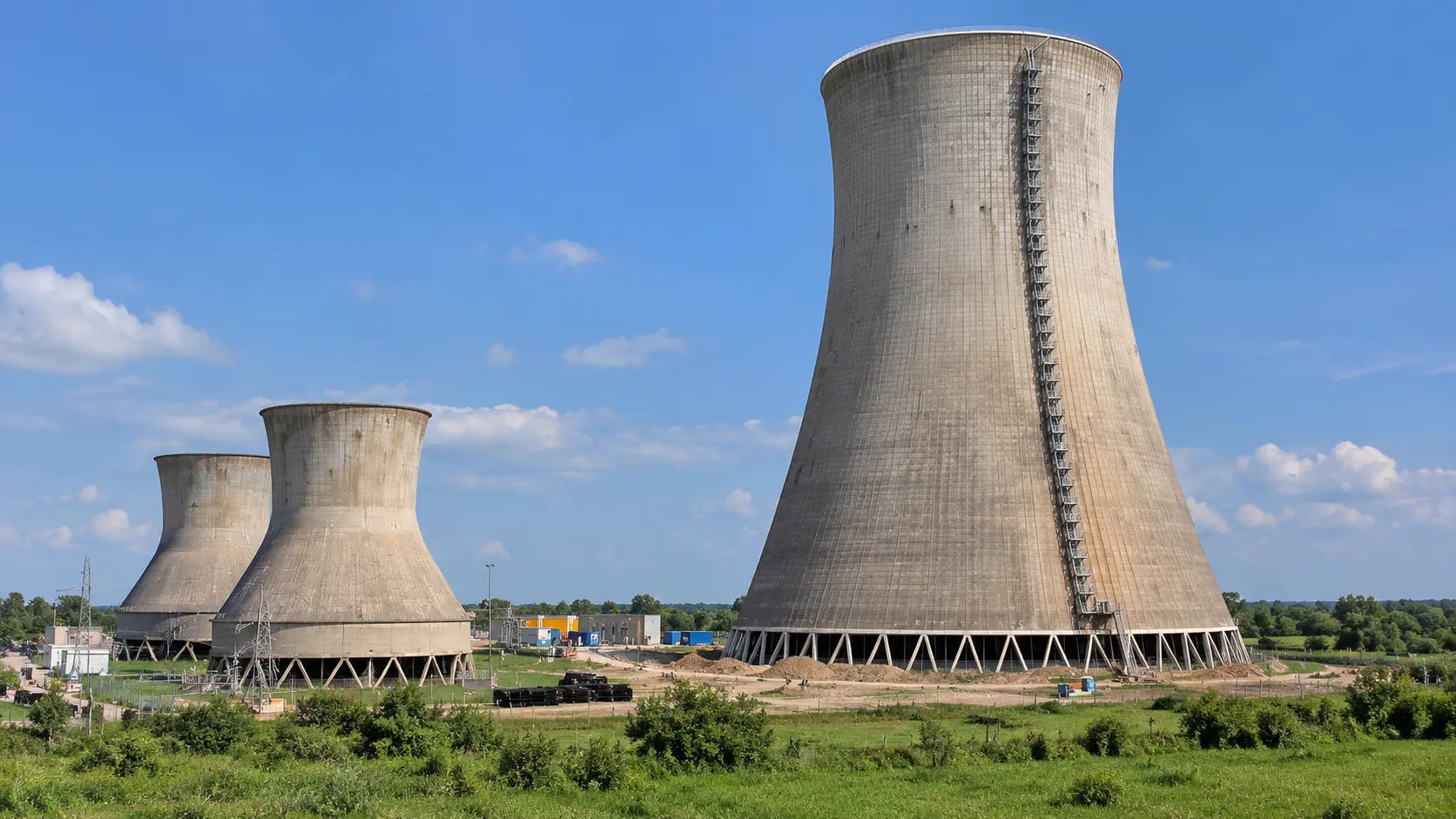
A natural-draft cooling tower is a very tall, hyperbolic concrete shell that cools water without a fan. Warm, moist air inside the tower is lighter than the air outside, so it rises by itself and pulls fresh air in at the base.
A natural-draft cooling tower uses the stack effect instead of fans. Hot water from a power plant condenser or a large process is sprayed over fill at the bottom of the shell. Outside air enters through the open base, takes up heat and moisture, and rises through the tall chimney. The height of the tower creates the draft, so there is no fan, no gearbox and no fan power bill. The trade-off is a large, expensive structure that takes a long time to build.
How a natural-draft cooling tower works
A power station or a large plant has a lot of heat to get rid of every hour of the day. The natural-draft cooling tower does it with water, air and gravity.
- Hot water arrives. Water that has passed through the steam condenser or process heat exchangers is carried to the tower in large pipes or ducts and fed to the distribution system inside the shell.
- It is spread over the fill. Spray nozzles or troughs spread the water evenly across the fill, which breaks it into thin films and droplets and gives it a very large surface.
- Air enters at the base. The shell stands on columns, so outside air flows in all the way around the bottom edge and moves up through the fill.
- Some water evaporates. Evaporation takes heat from the rest of the water, which cools it. The air leaves the fill warmer and almost saturated with moisture.
- The warm, moist air rises. It is lighter than the cooler air outside, so it climbs the shell and pulls new air in behind it. The flow keeps itself going as long as there is heat to reject.
- Cold water goes back. The cooled water falls into the cold-water basin at the foot of the tower and is pumped back to the plant. The moist air leaves the top as a white plume.
A wet natural-draft cooling tower is an open-circuit tower: the water that cools the plant is the water that touches the air. It cools in the same way as an open-circuit mechanical tower. The difference is that the height of the shell does the job of the fan.
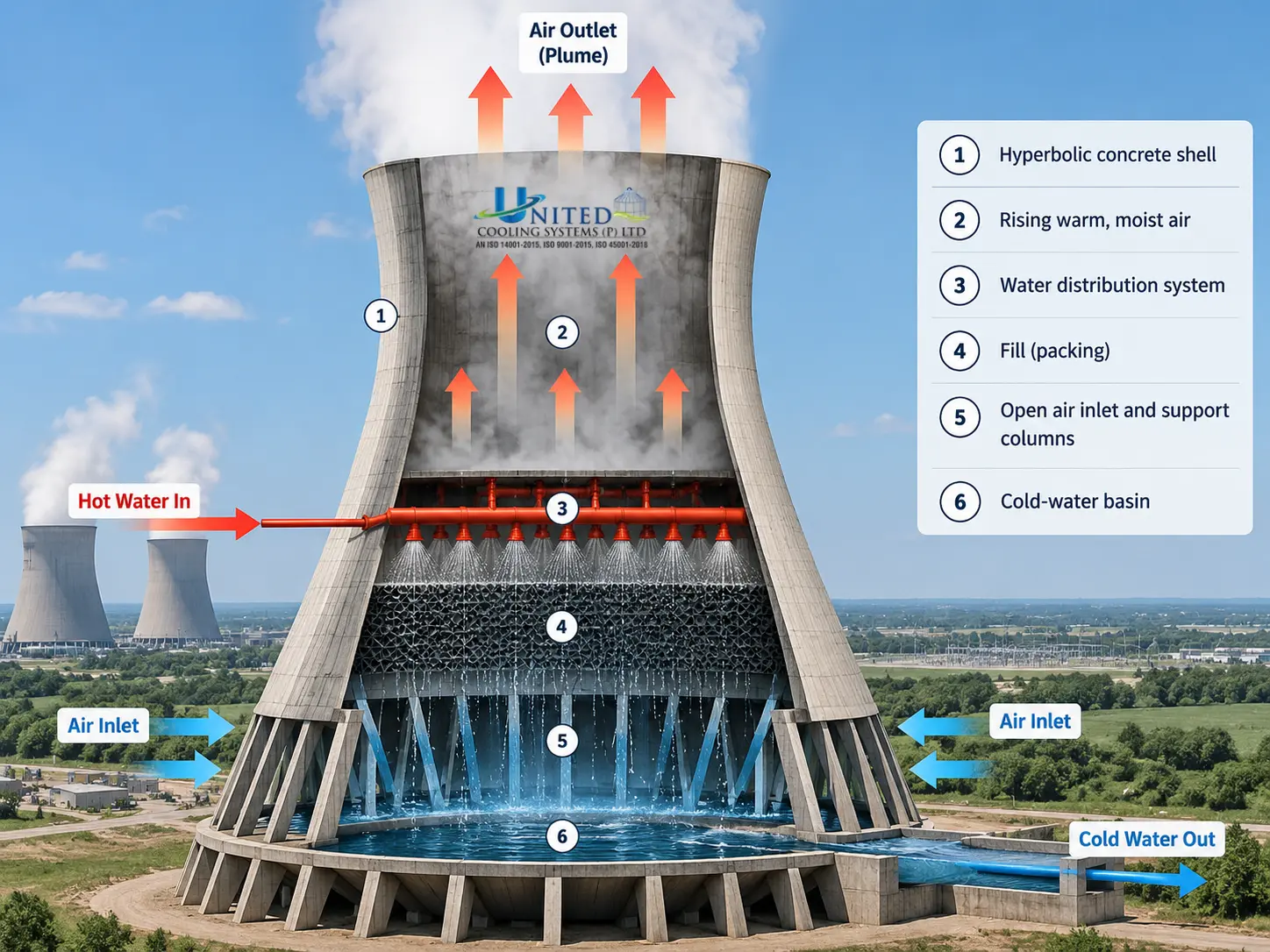
- Hyperbolic concrete shell
- Rising warm, moist air
- Water distribution system
- Fill (packing)
- Open air inlet and support columns
- Cold-water basin
Why height creates airflow
The airflow in a natural-draft cooling tower comes from a difference in density. Air inside the shell is warmer and holds more water vapor, so it weighs less per cubic meter than the air outside. The taller the column of light air, the bigger the pressure difference that pushes air through the tower.
In simple terms, the available draft is about g × H × (ρoutside − ρinside), where H is the effective height of the column of warm air and ρ is air density.
Assume outside air at 1.15 kg/m³, warm moist air inside at 1.10 kg/m³, and an effective height of 120 m. The draft is 9.81 × 120 × 0.05, which is about 59 Pa. That is a small pressure, so the inlet, fill and drift eliminators have to be designed for very low air resistance. These densities are assumed values for the example, not design data.
This is why natural-draft cooling towers are so tall. Height is the only way to get enough draft without a fan. It is also why they perform best when the air outside is cool and the air inside is much warmer. On hot, humid days the density difference shrinks and the draft weakens.
Main parts of a natural-draft cooling tower
- Hyperbolic shell. A thin reinforced-concrete wall, often only a few tens of centimeters thick, that forms the chimney and carries wind loads. It is usually stiffened with a ring at the top.
- Support columns and air inlet. The shell stands on inclined columns around its edge. The open space between them lets air flow in from all sides.
- Fill (packing). A block of film or splash fill placed above the rain zone. It gives the water a large surface so air and water can exchange heat and vapor.
- Water distribution system. A network of pipes, nozzles or troughs that spreads hot water evenly across the fill.
- Drift eliminators. Baffles above the distribution system that catch droplets before they leave with the air.
- Hot-water ducts or pipes. Large-diameter lines that bring water from the condenser or process into the tower.
- Cold-water basin. A concrete basin or pond at the foot of the tower that collects the cooled water for return to the plant.
- Draft
- The pressure difference that moves air through the tower. In a natural-draft cooling tower it comes from buoyancy, not from a fan.
- Stack effect
- Warm air rising in a tall column and pulling cooler air in behind it. Chimneys work the same way.
- Throat
- The narrowest part of the shell, about three quarters of the way up. Air speeds up as it passes through.
- Rain zone
- The open space between the bottom of the fill and the basin, where the cooled water falls through the incoming air.
- Range
- The drop in water temperature across the tower: hot water in minus cold water out.
- Approach
- Cold water temperature minus the ambient wet-bulb temperature. A smaller approach needs a bigger tower.
- Drift
- Fine droplets carried out of the tower by the air. It is separate from evaporation, which leaves as vapor.
Why the shape is hyperbolic
The curved, hourglass shape is not for looks. A hyperbolic shell has double curvature, which makes a thin concrete wall very strong and stiff. It reduces the amount of concrete needed, and it resists wind well. The narrowing at the throat also speeds up the air, which helps the cooling. The widening above the throat helps the exhaust air leave smoothly.
Types of natural-draft cooling towers
By cooling method
- Wet (evaporative) natural draft. The most common type. Water meets the air directly in the fill and cools by evaporation. This is the tower most people mean by “natural draft cooling tower”.
- Dry natural draft. Water circulates inside finned-tube heat exchangers around the base, and air passes over them. There is no evaporation, so water use is minimal and there is no plume. Heller-type systems work this way. Capital cost is higher and the water cannot be cooled as far, so dry towers are chosen mainly where water is scarce.
- Fan-assisted natural draft. A hybrid with fans at the base that add airflow when the natural draft is weak, which allows a shorter shell.
By flow arrangement
- Counterflow. Air moves up against falling water. This is the usual arrangement for large natural-draft cooling towers and is shown in the diagram.
- Crossflow. Air moves sideways through fill arranged around the base while water falls through it.
Looking for a Reliable Cooling Tower?
Share your application and cooling requirements with our team and get the right cooling tower solution for your project.
Natural draft vs mechanical draft cooling tower
Both cool water by evaporation. The difference is what moves the air.
| Natural draft | Mechanical draft | |
|---|---|---|
| Air movement | Buoyancy from the tall shell (stack effect). | Fans, either induced draft or forced draft. |
| Fan power | None. | Needed, and a large share of running cost. |
| Height | Very tall, often well over 100 m at power stations. | Low, usually well under 30 m. |
| Capital cost | High, because of the concrete shell and long build time. | Lower, and modular cells can be added in stages. |
| Operating and maintenance cost | Low. Few moving parts. | Higher. Fans, motors and gearboxes need upkeep. |
| Noise | Low. Mostly falling water. | Fan and water noise. |
| Control | Limited. Performance follows the weather. | Fan speed can be adjusted to load and conditions. |
| Footprint | Large. | Smaller for the same duty in most cases. |
| Best suited to | Very large, steady heat loads over many years, such as power stations. | Industrial plants, HVAC and variable or smaller loads. |
Advantages and disadvantages
Advantages
- No fan power, so operating energy is very low.
- Few moving parts, so maintenance and breakdown risk are low.
- Quiet in operation, with no fan noise.
- Very large cooling capacity from one structure.
- Exhaust leaves high above the ground, away from the air inlet.
- A concrete shell can serve for decades.
Disadvantages
- High capital cost and a long construction period.
- Large footprint and a very visible structure, which can make planning approval harder.
- Performance depends on weather. Hot, humid days reduce draft and cooling.
- Little control over airflow once built.
- Not economical for small or short-term loads.
- A wet tower still needs water treatment and uses make-up water.
Where natural-draft cooling towers are used
They suit sites that need a large, constant cooling duty for many years.
- Thermal power stations. Coal-fired plants are the most familiar users, and in India most large coal-fired stations have hyperbolic towers.
- Nuclear power plants. Many have large natural-draft cooling towers to cool the condenser water.
- Large combined-cycle plants where the steam cycle needs a big condenser cooling system.
- Very large industrial complexes with a steady, heavy heat load, where the long life and low running cost justify the investment.
The size of these structures is striking. The tallest cooling tower listed on Wikipedia is at the Pingshan II power station in China, at about 210 m. India’s Kalisindh thermal power station in Rajasthan has towers about 202 m tall.
Is the white cloud smoke?
No. The white plume rising from a natural-draft cooling tower is mostly water vapor that condenses into tiny droplets as the warm, moist air meets cooler air. The tower itself burns nothing. The plume is larger and lasts longer on cold, humid days, and it can nearly disappear in hot, dry weather.
Water treatment and upkeep
A wet natural-draft cooling tower is an open system, so the water has to be looked after just like in a mechanical tower. Even without fans, a good routine matters.
- Water chemistry. Control scale, corrosion and biological growth with treatment and blowdown. Higher cycles of concentration save water but raise the risk.
- Fill and nozzles. Check for blockage, fouling and damage. Uneven distribution reduces cooling.
- Drift eliminators. Keep them clean and in place to limit water loss and mist.
- Concrete shell. Inspect for cracks and spalling, and repair them early.
- Basin. Clean it on schedule and keep strainers clear.
- Legionella control. Follow a written water management plan, such as the approach in ASHRAE Standard 188, and local rules.
Frequently asked questions
What is a natural-draft cooling tower in simple words?
It is a very tall concrete chimney-shaped tower that cools water. Hot water is sprayed inside the bottom, air flows in from the base, and the warm air rises through the tower on its own, so no fan is needed.
How does a natural-draft cooling tower work without a fan?
Air that has picked up heat and moisture from the water is lighter than the air outside. It rises up the tall shell, and cooler air flows in at the base to replace it. This continuous flow is called the stack effect.
Why are natural-draft cooling towers hyperbolic?
A hyperbolic shape is strong, so the concrete wall can be thin. It also reduces the material needed and speeds up the airflow at the throat.
What is the difference between natural draft and mechanical draft cooling towers?
A natural-draft cooling tower moves air by buoyancy and needs a very tall shell. A mechanical-draft tower uses fans, so it can be much shorter and gives more control, but it uses fan power and needs more mechanical maintenance.
How tall is a natural-draft cooling tower?
Large power-station towers are commonly well over 100 m tall. The tallest on record is about 210 m, and India’s tallest at Kalisindh are about 202 m.
Where are natural-draft cooling towers used?
Mainly at large thermal and nuclear power stations, and occasionally at very large industrial sites with a steady heat load.
Do natural-draft cooling towers use less water?
Not a wet one. Evaporation depends on how much heat is rejected, so a wet natural-draft cooling tower loses about as much water as a mechanical-draft tower doing the same duty. Dry natural-draft systems use very little water but cost more and cool less deeply.
Is a natural-draft cooling tower an open-circuit cooling tower?
A wet natural-draft cooling tower is. The process water touches the air directly in the fill. A dry natural-draft system is different, because the water stays inside finned tubes and never touches the air.
Need the Right Cooling Tower for Your Application?
Get expert guidance on selecting an efficient and reliable cooling tower designed around your process requirements and cooling needs.