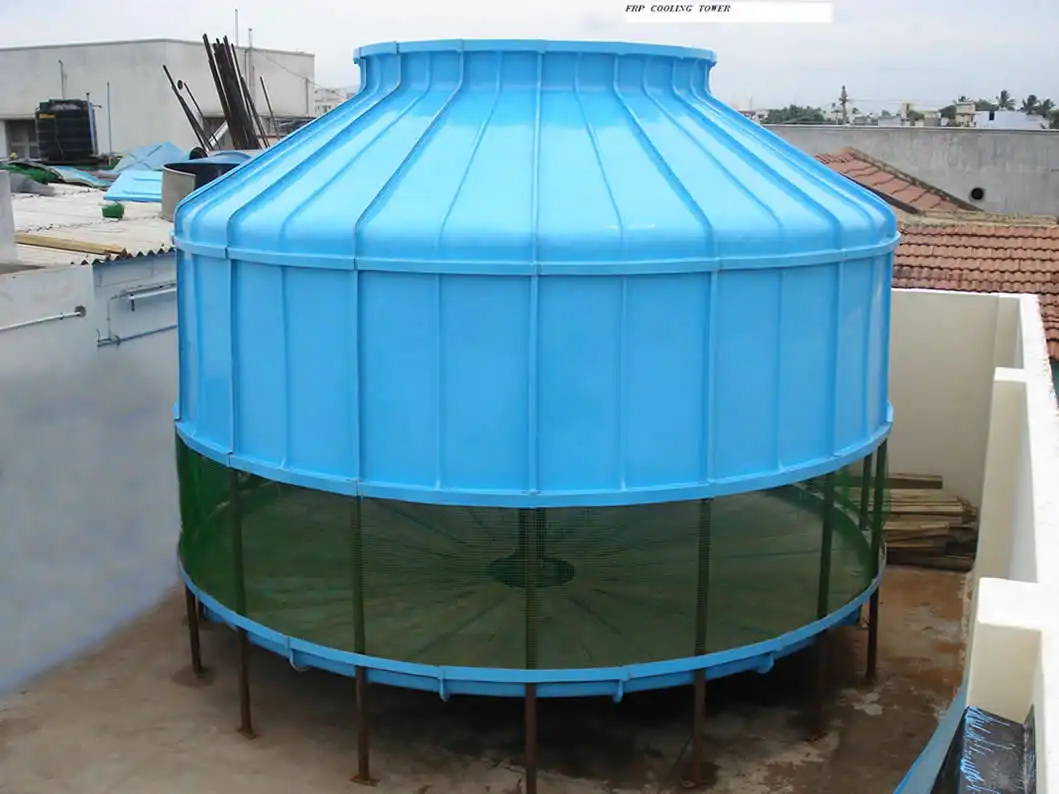
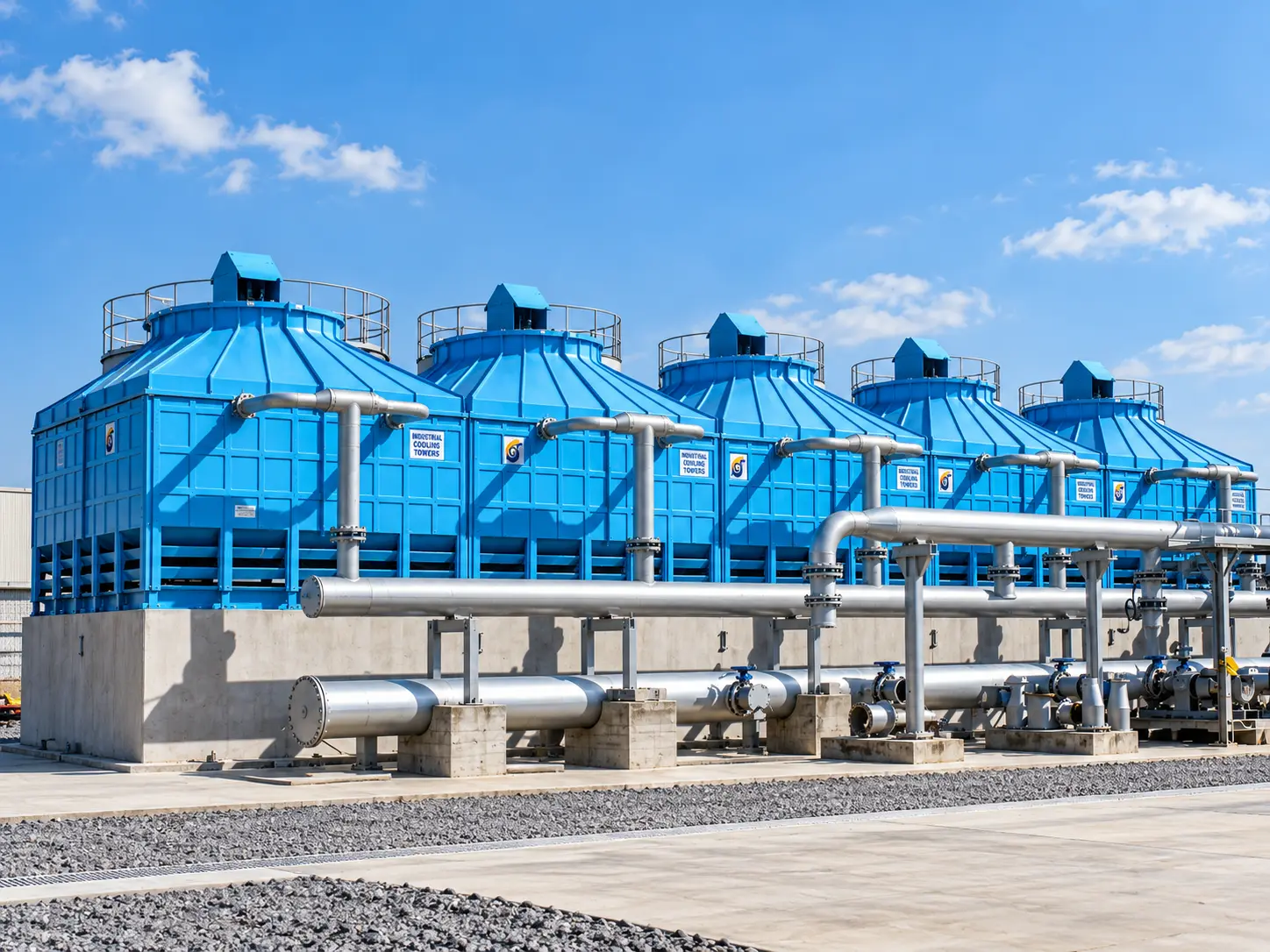
What is an Induced-draft cooling tower?
An induced-draft cooling tower is a mechanical-draft cooling tower with its fan at the top. The fan pulls air up through the tower, so the air crosses the falling water and leaves through the fan stack.
In an induced-draft cooling tower, hot water from a chiller condenser or an industrial process is sprayed over fill. A fan on top of the tower draws outside air in through the louvers and up through the fill. A small part of the water evaporates and carries heat away, and the cooled water collects in a basin and returns to the plant. Because the fan sits in the exhaust air stream, the warm, moist air leaves at high speed and is thrown clear of the air inlet. That makes induced draft the most common design in industry and HVAC.
How an induced-draft cooling tower works
Equipment such as chiller condensers, compressors, furnaces and injection molding machines heat up cooling water. The tower gets rid of that heat by moving air through the water.
- Hot water arrives. Water that has absorbed heat from the process is pumped to the top of the tower.
- It is spread over the fill. Spray nozzles or distribution basins spread the water evenly across the fill, which breaks it into thin films and gives it a very large surface.
- The fan pulls air in. A fan at the top of the tower creates a slight vacuum inside. Outside air flows in through the louvers and up through the fill.
- Some water evaporates. Evaporation takes heat from the remaining water. This is the main way the water is cooled.
- Drift eliminators catch droplets. Baffles above the water distribution capture most of the fine droplets before the air passes through the fan.
- Warm, moist air leaves at the top. The fan discharges it upward through the stack at high speed, which carries it away from the air inlet. The cooled water falls into the basin and is pumped back to the process.
The tower is called “induced” because the fan induces, or draws, air through the tower instead of pushing it in. The fan works on the exhaust side, in the leaving air.
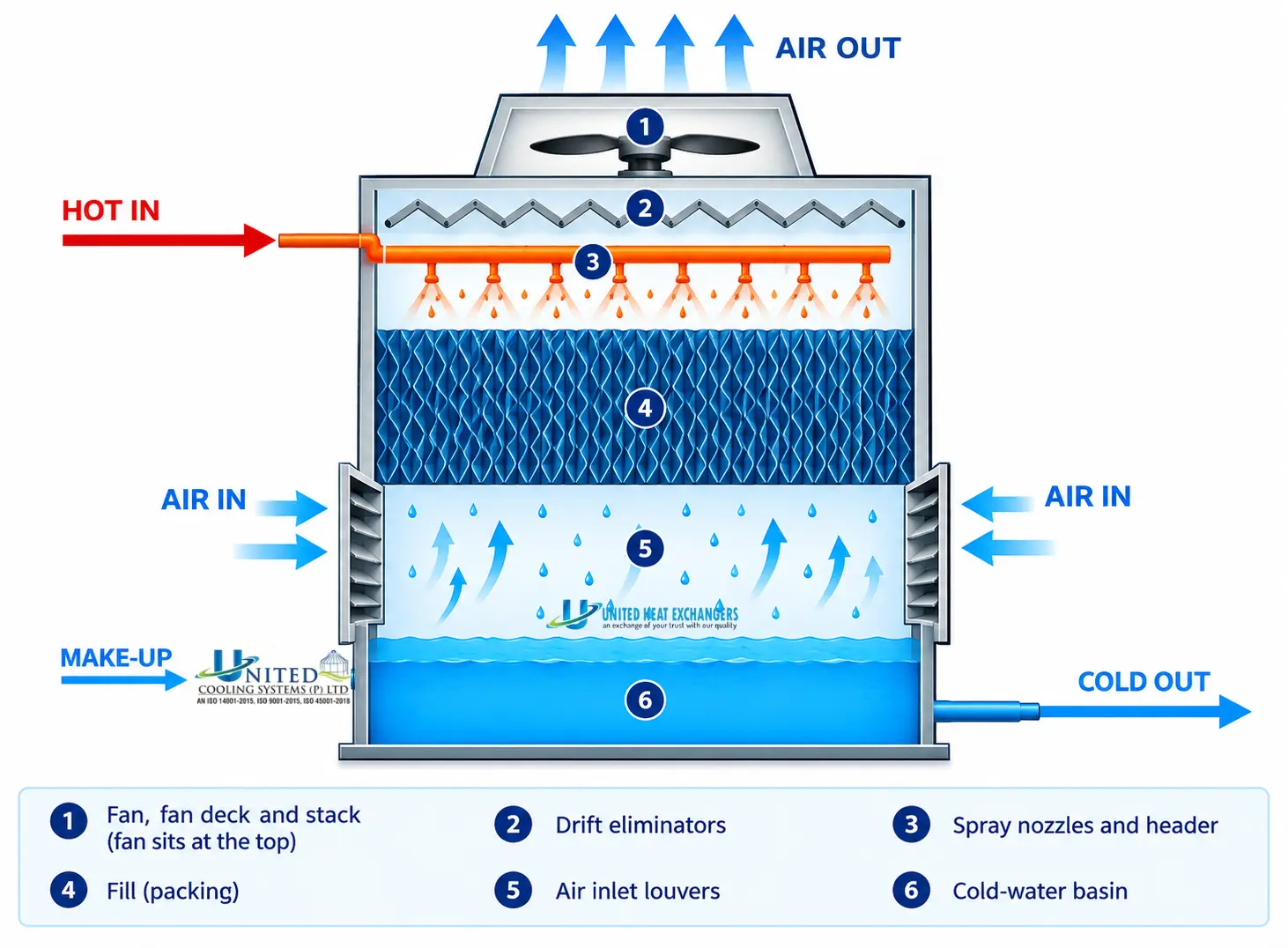
Main components of an induced-draft cooling tower
- Fan. Usually an axial propeller fan with several blades, mounted in a shaped cylinder (the fan stack). Large towers use big, slow fans for good efficiency. Small towers may use several fans.
- Motor and drive. An electric motor drives the fan through a gear reducer or a belt, or directly in small units. A variable frequency drive lets the fan slow down when the load or the weather allows.
- Fan stack (velocity recovery cylinder). The shaped outlet around the fan. It reduces losses at the fan and directs the exhaust air upward.
- Fill (packing). Film fill gives the most cooling per unit volume. Splash fill suits dirtier water.
- Water distribution system. Pipes and nozzles, or open distribution basins in crossflow towers, that spread water over the fill.
- Drift eliminators. Baffles that remove entrained droplets from the air before the fan.
- Louvers. Guide air into the tower and keep splashing water inside.
- Cold-water basin and sump. Collects cooled water and holds make-up water, usually controlled by a float valve. A strainer protects the pump.
- Casing and structure. Commonly fiberglass-reinforced plastic (FRP), galvanized or stainless steel, or concrete. Factory-built cells can be bolted together on site.
Terms you will see on a datasheet
- Range
- The drop in water temperature across the tower: hot water in minus cold water out.
- Approach
- Cold water temperature minus the ambient wet-bulb temperature. A smaller approach needs a larger, more expensive tower.
- Wet-bulb temperature
- The lowest temperature air can reach by evaporating water into it. The tower can cool water toward this value but never below it.
- Cell
- One self-contained section of a tower, with its own fan and fill. Large towers are built as several cells so some can be shut down at partial load.
- Recirculation
- Exhaust air that finds its way back into the air inlet. It raises the inlet wet-bulb temperature and weakens cooling.
- Make-up water
- Fresh water added to replace evaporation, blowdown and drift.
- Blowdown
- Water drained from the loop to keep dissolved solids under control.
- Drift
- Fine droplets carried out by the air. It is separate from evaporation, which leaves as vapor.
A plant circulates 1,000 m³/h of water with a 5 °C range. That rejects about 5.8 MW. Evaporation is roughly 1% of the flow for every 5.6 °C of range, so about 9 m³/h leaves as vapor. With 4 cycles of concentration, blowdown is about 3 m³/h and make-up is about 12 m³/h, before counting drift. If the site’s design wet-bulb is 28 °C and the approach is 4 °C, the cold water leaves at about 32 °C and the hot water enters at about 37 °C. These figures are illustrative.
Counterflow and crossflow induced-draft towers
Induced-draft towers come in two main layouts, which differ in how the air meets the water.
| Counterflow | Crossflow | |
|---|---|---|
| Air path | Air moves up through the fill, against the falling water. | Air moves sideways through the fill, across the falling water. |
| Water distribution | Pressurized spray nozzles and pipes. | Gravity flow from open distribution basins on top of the fill. |
| Pumping head | Higher, because water must reach the spray nozzles. | Lower, because gravity basins need less pressure. |
| Footprint | Smaller for the same duty. | Larger, and usually taller. |
| Access for maintenance | Fill is under the nozzles, so inspection is harder. | Open basins and fill are easy to see and clean while running. |
| Fouling and algae | Spray area is enclosed, so there is less sunlight in the water. | Open basins can grow algae unless they are covered. |
| Typical use | Where space is limited and thermal performance matters. | Large industrial and power plants with dirtier water or a need for easy access. |
Looking for a Reliable Cooling Tower?
Share your application and cooling requirements with our team and get the right cooling tower solution for your project.
Induced draft vs forced draft cooling tower
Both are mechanical-draft towers. The difference is where the fan sits.
| Induced draft | Forced draft | |
|---|---|---|
| Fan position | At the top, in the exhaust air stream. | At the air inlet, at the bottom, pushing air in. |
| Exhaust air speed | High, so the plume is thrown well clear of the inlet. | Low, so the exhaust can sink and be drawn back in. |
| Recirculation | Low. | Higher, especially in wind. |
| Fan environment | Warm, humid air and possible icing in cold weather. | Dry ambient air, which is easier on the fan. |
| Fan and motor access | At height, so maintenance is harder. | At ground level, so maintenance is easier. |
| Height | Taller. | Lower, which suits indoor or low-profile sites. |
| Static pressure | Lower. Suited to open outdoor installations. | Can work against higher static pressure, for example with ducting. |
| Typical use | Most industrial and HVAC towers. | Small or compact towers, and indoor or ducted installations. |
Induced draft vs natural draft
A natural-draft cooling tower has no fan. It relies on a very tall shell to move air by buoyancy, which suits very large power stations. An induced-draft tower uses a fan, so it is much shorter, cheaper to build and easier to control. The cost of that control is fan power and mechanical maintenance. For most industrial plants, HVAC systems and mid-size process loads, induced draft is the practical choice.
Advantages and disadvantages
Advantages
- High exhaust speed throws warm, moist air clear of the inlet, so recirculation is low.
- Even airflow through the fill, which gives good, consistent cooling.
- Fan speed can be adjusted or cells switched off to match load and weather.
- Much lower capital cost and shorter build time than a natural-draft tower.
- Modular cells let you add capacity in stages.
- Wide range of sizes and materials, from small packaged units to large field-erected towers.
Disadvantages
- Uses fan power, which is a large part of running cost.
- Fan, motor and gearbox sit at height, in warm, humid air, so they are harder to reach and more exposed to corrosion.
- Fans can ice up in very cold weather unless reverse or low-speed operation is used.
- Fan noise, which may need attenuators near homes and offices.
- Mechanical parts need regular inspection and replacement.
- A wet tower still needs water treatment and make-up water.
Where induced-draft cooling towers are used
- HVAC and chilled water plants in offices, hospitals, hotels, malls, airports and campuses.
- Data centers for the heat rejection side of chilled water systems.
- Power plants of small and medium size, and auxiliary cooling at large ones.
- Oil, gas, refineries and petrochemicals for process and compressor cooling.
- Steel, metals and foundries for furnaces, casting and rolling mills.
- Chemicals, pharmaceuticals and fertilizers for reactors, distillation and utilities.
- Food and beverage, textiles, plastics and paper for process cooling and chillers.
What decides the size of the tower
A supplier needs a few numbers to select an induced-draft tower. Sending these with an enquiry speeds up the quote.
- Heat load or water flow in kW, TR or m³/h.
- Hot water and cold water temperatures, which set the range.
- Design wet-bulb temperature for the site. This sets the approach.
- Water quality and any contaminants such as oil or suspended solids.
- Space, height and noise limits on the site.
- Material preference such as FRP, galvanized steel, stainless steel or concrete.
- Duty pattern: constant load or variable, and how many hours a day it runs.
Water treatment and upkeep
A wet induced-draft tower is an open system, so the water needs treatment and the machinery needs regular checks.
- Water chemistry. Control scale, corrosion and biological growth with treatment and blowdown.
- Fan and drive. Check blade pitch and tip clearance, vibration, gearbox oil level and motor condition.
- Fill and nozzles. Clean or replace blocked fill and nozzles. Uneven distribution lowers performance.
- Drift eliminators. Keep them clean and complete to limit water loss and mist.
- Basin and strainers. Clean on schedule and keep strainers clear.
- Winter operation. In cold climates, use fan control, reverse running or basin heaters to prevent ice.
- Legionella control. Follow a written water management plan, such as the approach in ASHRAE Standard 188, and local rules.
Watch the approach temperature at a steady load. If it rises, something is fouled or the airflow has dropped.
Frequently asked questions
What is an induced-draft cooling tower in simple words?
It is a cooling tower with a fan on top that sucks air up through falling water. Some water evaporates, which cools the rest. The cooled water is collected at the bottom and sent back to the plant.
Why is it called induced draft?
The fan induces, or draws, air through the tower from the exhaust side. In a forced-draft tower the fan sits at the air inlet and pushes air in instead.
What is the difference between induced draft and forced draft cooling towers?
In an induced-draft tower the fan is on top and pulls air through. In a forced-draft tower the fan is at the base and pushes air in. Induced draft has less recirculation because the exhaust leaves at high speed. Forced draft has lower height and easier fan access.
Is an induced-draft cooling tower an open-circuit tower?
A standard one is. The process water touches the air directly in the fill. The fan arrangement and the circuit type are separate choices, so a closed-circuit tower can also be induced draft.
Which is better, counterflow or crossflow?
Counterflow is more compact and gives strong thermal performance. Crossflow has lower pumping head and easier access. The choice depends on space, water quality, maintenance preferences and cost.
Where is the most common use of induced-draft cooling towers?
HVAC chiller plants and industrial process cooling. They are the most common type of cooling tower in commercial and industrial sites.
How do I reduce the running cost of an induced-draft tower?
Fit a variable frequency drive and slow the fan when load or weather allows. Keep the fill and nozzles clean, keep the drift eliminators in place, and treat the water so the approach stays low.
Does an induced-draft tower lose a lot of water?
Mostly through evaporation, which is roughly 1% of the circulating flow for each 5.6 °C of range. Blowdown and a small amount of drift add to that. Good drift eliminators and sensible cycles of concentration keep the total down.
Need the Right Cooling Tower for Your Application?
Get expert guidance on selecting an efficient and reliable cooling tower designed around your process requirements and cooling needs.