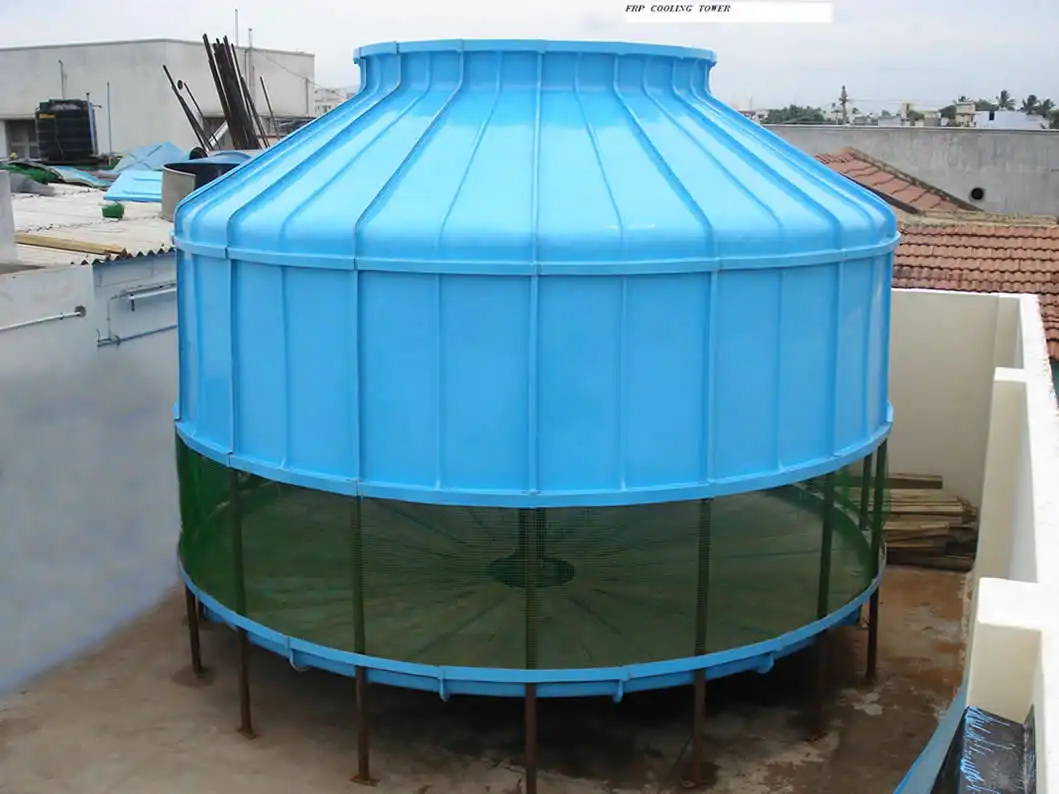
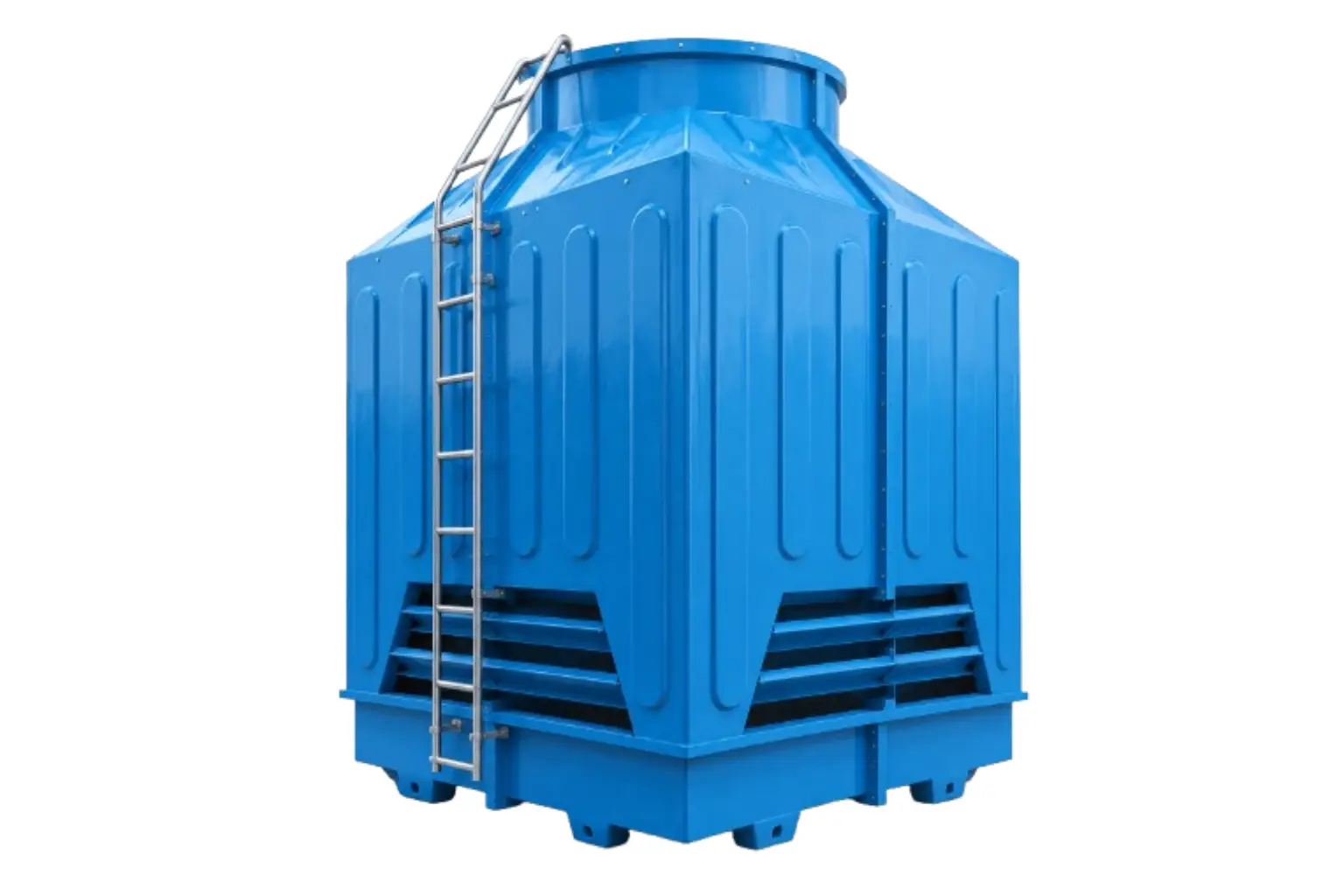
What is a Open-circuit cooling tower?
An open-circuit cooling tower, also called an open cooling tower or direct-contact cooling tower, cools water by letting it fall through moving air. A small part of the water evaporates, and that evaporation carries heat out of the rest.
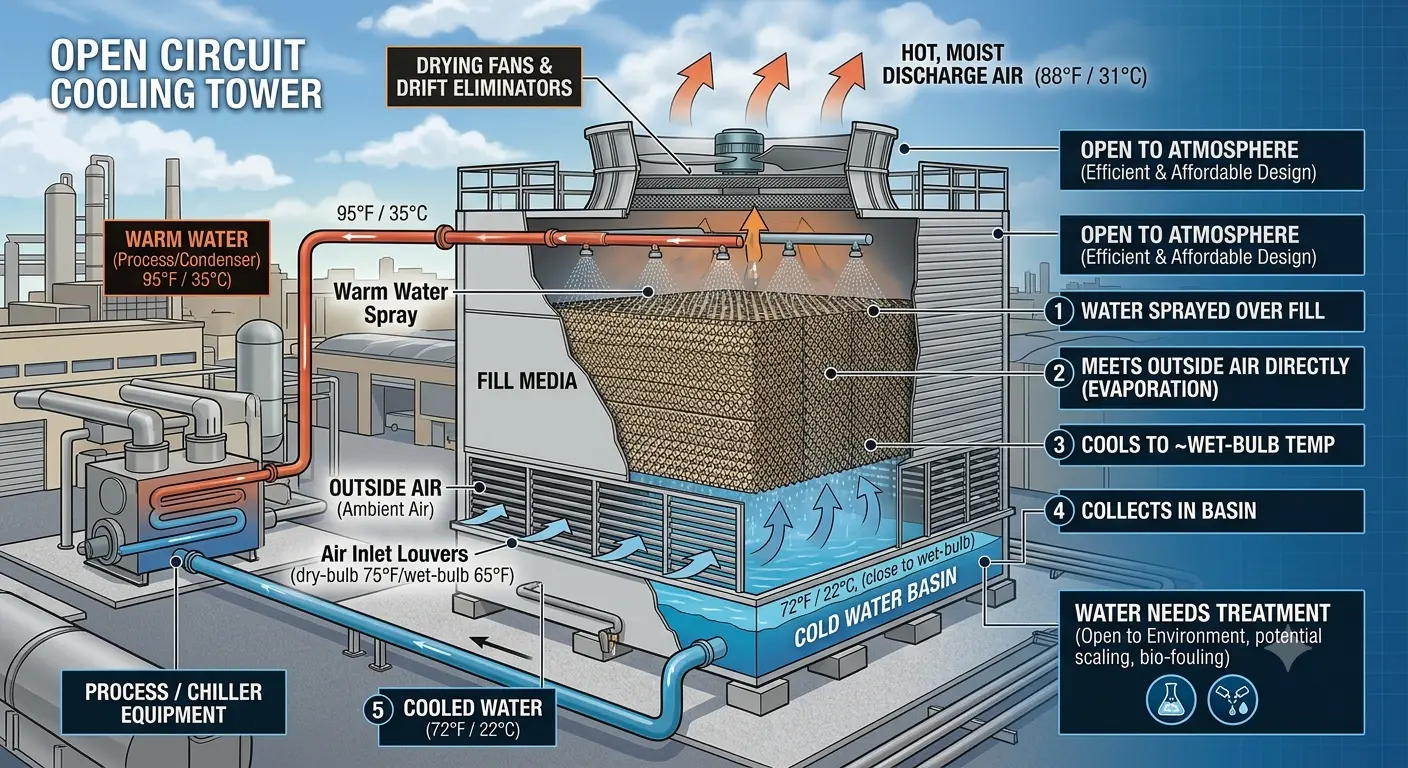
In an open circuit cooling tower the warm water from your process or chiller condenser is sprayed over fill inside the tower and meets outside air directly. It is cooled to a few degrees above the air’s wet-bulb temperature, collects in a basin, and goes back to the equipment. The water is open to the atmosphere, which makes the design efficient and affordable, and also means the water needs treatment.
How an open-circuit cooling tower works
Many industrial and HVAC systems produce heat that has to go somewhere. A chiller condenser, an air compressor, a furnace jacket or a plastics machine all heat up a stream of water. The open-circuit cooling tower is where that water gives the heat back to the atmosphere.
- Warm water arrives. Water that has absorbed heat from the process is pumped to the top of the tower.
- It is spread out. A header and spray nozzles distribute the water evenly over the fill, a block of corrugated sheets or splash bars that breaks the flow into thin films and droplets.
- Air moves through the fill. A fan, or in very large towers the natural chimney effect, pulls outside air through the falling water.
- A little water evaporates. Turning liquid into vapor takes a lot of energy, and that energy comes from the remaining water. This is what cools it. Sensible heat transfer to the air adds a smaller share.
- Cooled water collects in the basin. Gravity brings it to the cold-water basin, and a pump sends it back to the process to pick up heat again.
- Moist air leaves the top. Drift eliminators catch most of the entrained droplets before the warm, saturated air exits the fan stack.
The word “open” describes the water loop. The same water that passes through your heat exchanger is the water that touches the air in the tower. A closed-circuit tower keeps those two apart with a coil.
Hot water enters at the top left and is sprayed over fill. Air enters through louvers at the bottom, rises through the fill and leaves through a fan at the top. Cooled water collects in a basin and leaves on the right.
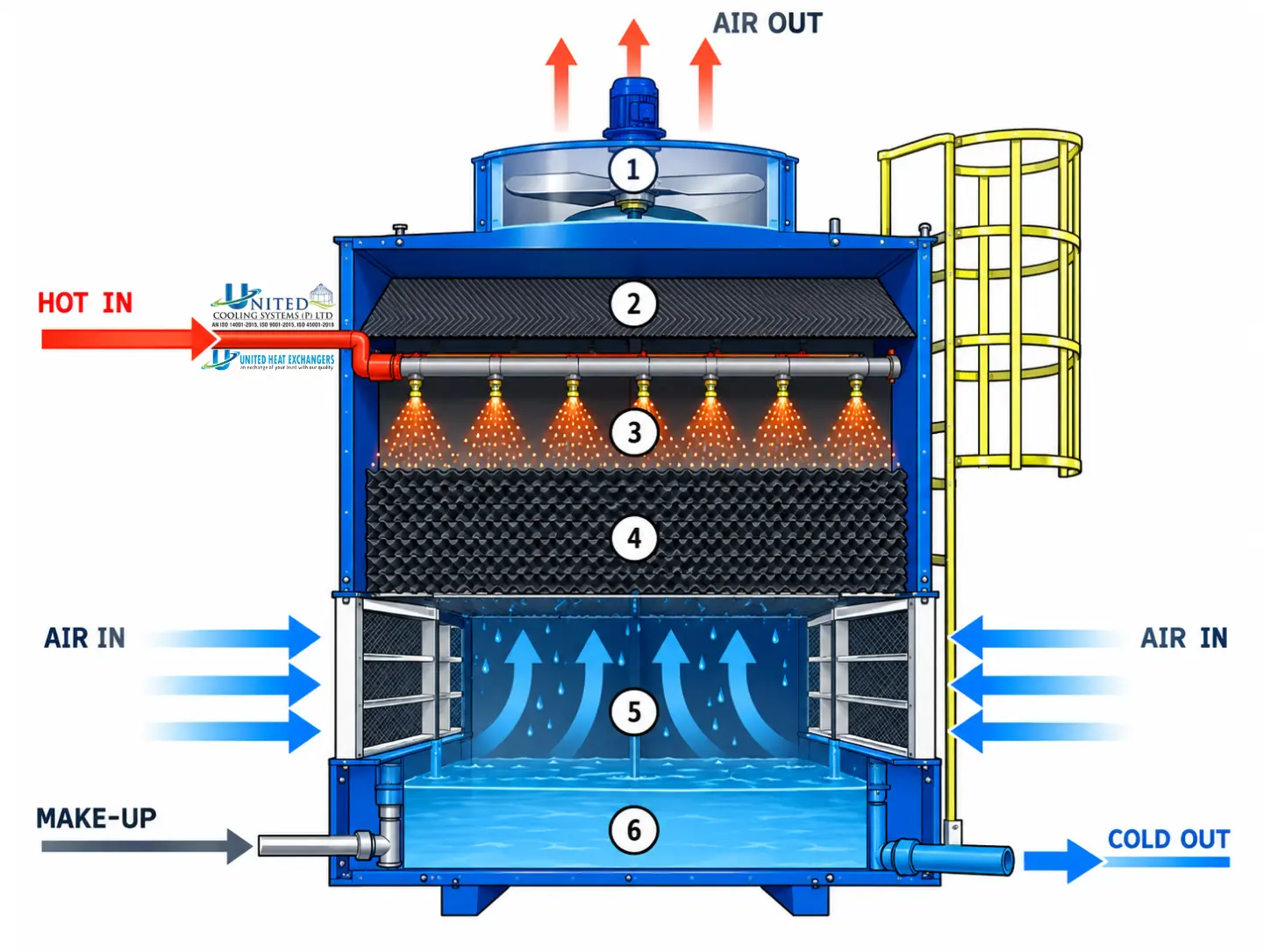
- Fan and stack
- Drift eliminators
- Spray nozzles and header
- Fill (packing)
- Air inlet louvers
- Cold-water basin
Main components of an open cooling tower
Every open-circuit tower, from a small rooftop unit to a large industrial cell, is built from the same few parts.
- Fill (packing). Creates a large wet surface so water and air have more contact. Film fill uses thin corrugated sheets and gives the most cooling per cubic meter. Splash fill uses bars that break water into droplets and tolerates dirtier water.
- Distribution system. Pipes and spray nozzles, or gravity basins with orifices, that spread water evenly across the fill. Poor distribution leaves dry spots and weakens performance.
- Fan and motor. Moves air through the tower. Many installations now use variable frequency drives to match fan speed to the load and the weather.
- Drift eliminators. Louvered baffles that capture droplets carried by the air stream, which reduces water loss and the spread of water mist.
- Air inlet louvers. Guide air into the tower and keep splashing water inside.
- Cold-water basin. Collects the cooled water and holds make-up water, usually controlled by a float valve. A sump and strainer protect the pump.
- Casing and structure. Typically fiberglass-reinforced plastic (FRP), galvanized or stainless steel, concrete or treated wood.
Terms you will see on a datasheet
- Range
- The temperature drop of the water across the tower: hot water in minus cold water out.
- Approach
- Cold water temperature minus the ambient wet-bulb temperature. A smaller approach means a larger, more expensive tower. Design approaches are commonly in the 3 to 5 °C range.
- Wet-bulb temperature
- The lowest temperature air can reach by evaporating water into it. An open tower can cool water down toward the wet-bulb temperature, but never below it.
- Make-up water
- Fresh water added to replace what is lost to evaporation, blowdown and drift.
- Blowdown
- Water deliberately drained from the loop to keep dissolved solids from building up.
- Cycles of concentration
- How concentrated the dissolved solids in the circulating water are compared with the make-up water. Higher cycles save water, but raise scaling and corrosion risk.
- Drift
- Fine liquid droplets carried out of the tower by the air. It is different from evaporation, which leaves as vapor.
A loop circulates 1,000 m³/h and the tower cools it by a 5 °C range. That rejects about 5.8 MW of heat. Evaporation is roughly 1% of the flow for every 5.6 °C (10 °F) of range, so about 9 m³/h of water leaves as vapor. At 4 cycles of concentration, blowdown is about 3 m³/h and make-up is about 12 m³/h, before counting drift.
Types of open cooling towers
Open-circuit towers are grouped by how air is moved and how air meets water.
By airflow
- Natural draft. Large hyperbolic concrete chimneys where warm, moist air rising creates the flow. No fans. Mostly seen at power stations.
- Mechanical draft, induced. The fan sits at the top and pulls air up through the tower. This is the most common choice for industrial and commercial sites.
- Mechanical draft, forced. The fan sits at the air inlet and pushes air in. It is compact and quiet, but is more exposed to recirculation of its own exhaust.
By flow arrangement
- Counterflow. Air moves upward against falling water. Smaller footprint and good thermal performance, with a taller pumping head.
- Crossflow. Air moves sideways across falling water. Lower pumping head and easier access to the fill, with a larger footprint.
Looking for a Reliable Cooling Tower?
Share your application and cooling requirements with our team and get the right cooling tower solution for your project.
Open circuit vs closed circuit cooling tower
The two designs use the same evaporative principle. The difference is whether the process water touches the air.
| Open circuit | Closed circuit | |
|---|---|---|
| Water and air | Process water is in direct contact with the air. | Process fluid runs inside a coil. A separate spray loop is cooled by the air. |
| Cold water temperature | Can reach a lower temperature because of direct contact. | Slightly higher, because heat passes through the coil wall first. |
| Initial cost | Generally lower. | Higher, because of the coil and second water loop. |
| Fan and pump energy | Generally lower for the same duty. | Generally higher. |
| Process water quality | Exposed to dust, debris and airborne contaminants, so it needs filtration and treatment. | Stays clean and sealed. Suits critical equipment and glycol mixtures. |
| Typical use | HVAC condenser water, power, process cooling where water quality is manageable. | Clean-loop applications, heat pumps, equipment that cannot accept dirty water. |
Advantages and disadvantages
Advantages
- Lower purchase and installation cost than a closed-circuit tower of the same capacity.
- Direct contact gives efficient heat transfer and low cold-water temperatures.
- Cools below the ambient air temperature, because it works toward the wet-bulb temperature.
- Simple design that is easy to inspect and repair, with wide choice of sizes and materials.
- Scales from a few hundred kW to hundreds of MW.
Disadvantages
- The circulating water is open to the air, so it collects dust, debris and microorganisms.
- Needs continuous water treatment and regular blowdown.
- Water is consumed through evaporation, blowdown and drift.
- Scale and corrosion can build up in downstream heat exchangers if the chemistry slips.
- Visible plume in cool, humid weather and noise from fans and falling water.
Where open-circuit cooling towers are used
- HVAC and chilled water plants in offices, hospitals, hotels, malls and airports, rejecting condenser heat from chillers.
- Power generation for steam condensers and auxiliary cooling.
- Oil, gas, refineries and petrochemical plants for process streams and compressor cooling.
- Steel, metals and foundries for furnace, casting and rolling mill cooling.
- Chemical, pharmaceutical and fertilizer plants for reactors, distillation and utility systems.
- Food and beverage, textile and plastics for process cooling and injection molding chillers.
- Data centers as the heat rejection stage for chilled water systems.
Water treatment, upkeep and Legionella
Because the water is open to the air, three problems appear in every open-circuit system if they are left alone.
- Scale. As water evaporates, minerals concentrate and can deposit on fill and heat exchangers. Scale inhibitors and controlled blowdown limit it.
- Corrosion. Oxygen-rich water attacks metal. Corrosion inhibitors and the right materials protect pipes and exchangers.
- Biological growth. Warm, nutrient-rich water supports algae, slime and bacteria. Biocide programs, filtration and keeping basins clean control it.
Legionella needs particular attention. The bacteria can grow in poorly maintained systems, and a tower can release fine mist that people nearby may breathe in. Good practice follows a written water management plan, such as the approach set out in ASHRAE Standard 188, and local regulations. That plan typically covers regular inspection, cleaning and disinfection, treatment records, drift eliminator condition and routine water testing.
For the tower itself, a simple routine keeps performance steady: check nozzles and fill for blockage, inspect fan, motor and gearbox, clean the basin and strainer, confirm the make-up valve works, and watch the approach temperature. A rising approach at the same load is the earliest sign something is fouled.
Frequently asked questions
What is an open-circuit cooling tower in simple words?
It is a structure where warm water trickles down through moving air. A small amount of the water evaporates and takes heat with it, so the water that reaches the bottom is cooler and can be reused.
What is the difference between open and closed circuit cooling towers?
In an open circuit tower the process water itself touches the air. In a closed circuit tower the process fluid stays inside a coil and a separate water loop is sprayed over the outside of that coil. Open towers cost less and cool slightly better. Closed towers keep the process fluid clean.
How cold can an open cooling tower get the water?
It can approach the wet-bulb temperature of the air, but not reach it. A design approach of roughly 3 to 5 °C above wet-bulb is common. On a day with a 26 °C wet-bulb, that means cold water around 29 to 31 °C.
How much water does an open cooling tower use?
Evaporation takes roughly 1% of the circulating flow for each 5.6 °C of cooling range. Add blowdown, which depends on the cycles of concentration, and a small drift loss. Higher cycles and good drift eliminators reduce the total.
Is an open-circuit cooling tower the same as a wet cooling tower?
In everyday use, yes. “Wet” towers, evaporative towers and direct-contact open towers all describe the same idea: cooling by direct contact between water and air with partial evaporation.
Which industries use open circuit cooling towers most?
HVAC and chiller plants, power generation, refineries and petrochemicals, steel and metals, chemicals and pharmaceuticals, food processing and data centers.
When should I choose a closed-circuit tower instead?
Choose closed circuit when the fluid being cooled must stay clean or cannot be exposed to the air, for example glycol loops, water-source heat pumps or sensitive process equipment. Choose open circuit when cost and cooling performance matter most and the water can be treated and filtered.
Need the Right Cooling Tower for Your Application?
Get expert guidance on selecting an efficient and reliable cooling tower designed around your process requirements and cooling needs.